
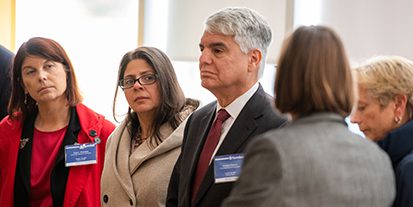
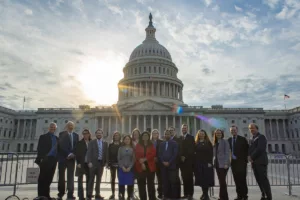
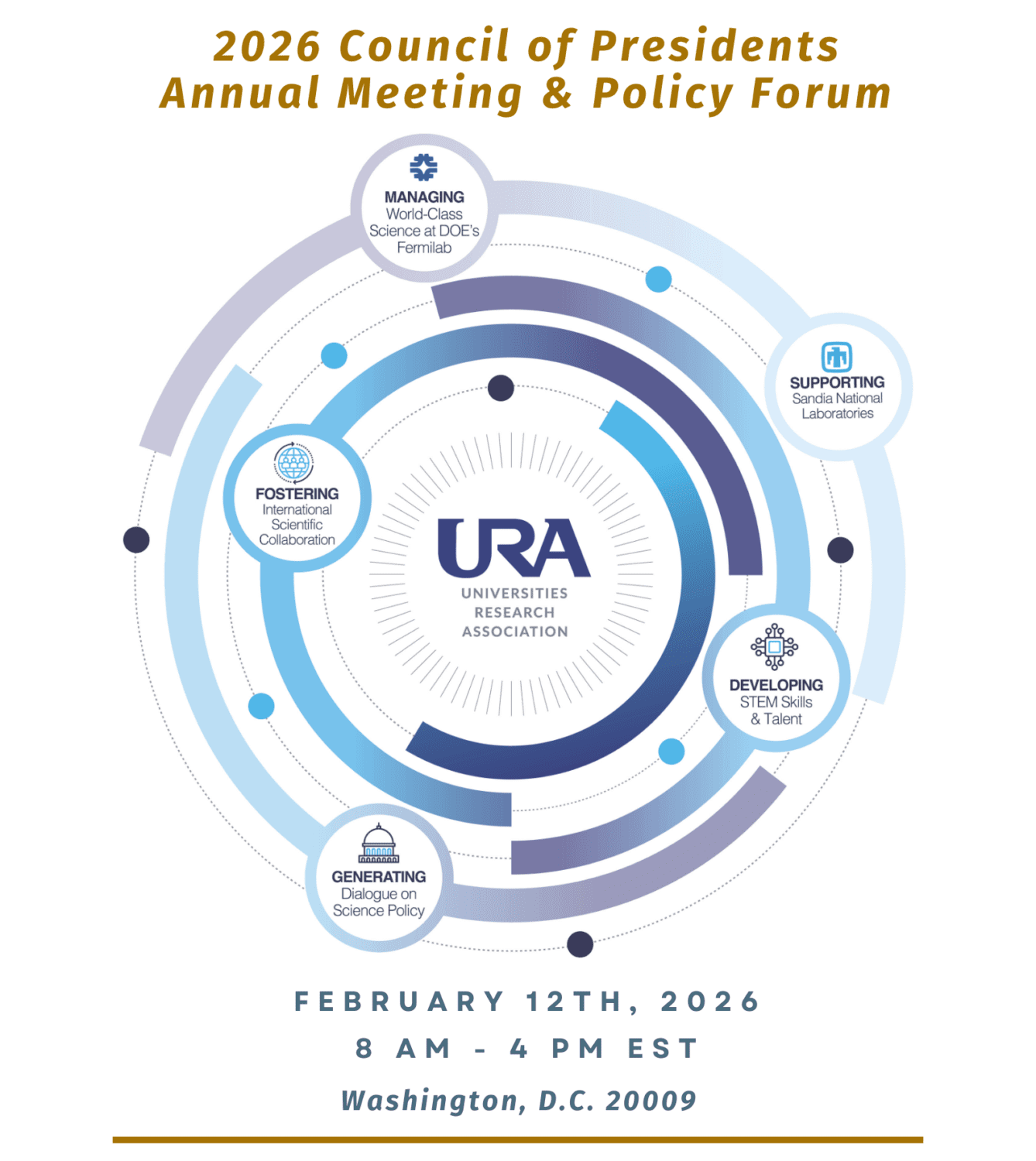
On February 12, 2026, Universities Research Association (URA) brought together university presidents, program awardees, and senior leaders from the U.S. Department of Energy (DOE) and the national laboratory system for the 2026 URA Council of Presidents (COP) Annual Meeting & Policy Forum. The forum served as a moment to reflect on shared priorities, examine emerging challenges, and reaffirm the partnerships that underpin the U.S. research enterprise.
Across the day, a consistent theme emerged: sustaining U.S. scientific leadership requires alignment across policy, institutions, infrastructure, and people. Perspectives from federal leadership, laboratory directors, university presidents, and early-career researchers together illustrated a coherent picture of where the nation’s science enterprise is headed and what it will take to sustain it.
Senior leadership from the U.S. Department of Energy opened the forum to outline the Department’s evolving science agenda and the critical role universities and national laboratories play in advancing discovery and innovation. Harriet Kung, Deputy Director for Science Programs in the DOE Office of Science (SC), described an ongoing SC realignment, designed to preserve strong stewardship of core scientific disciplines while addressing capacity needs. Kristen Ellis, Associate Principal Deputy Under Secretary for Science, framed the Department’s longer-term strategic direction by highlighting the Genesis Mission as a unifying effort to accelerate scientific discovery by deepening the integration of artificial intelligence, advanced computing, and cross-disciplinary research, while strengthening education and workforce pathways.
Dr. Norbert Holtkamp, newly appointed Director of Fermi National Accelerator Laboratory, focused his remarks on sharpening the laboratory’s portfolio to ensure the successful delivery of existing projects, most notably the Long-Baseline Neutrino Facility/Deep Underground Neutrino Experiment (LBNF/DUNE), while positioning Fermilab for sustained scientific leadership in the decade ahead. The importance of clear priorities, disciplined project execution, and strong stewardship of resources was central to Holtkamp’s remarks, reinforcing Fermilab’s role as a national asset and trusted partner to the university community, while affirming the laboratory’s commitment to delivering its flagship science program and strengthening collaborations that advance frontier research and emerging technologies.
Congressman Bill Foster (D-IL), the only PhD physicist currently serving in Congress, offered a congressional perspective on science policy and large-scale research initiatives, emphasizing the need to maintain public trust in science, deliver flagship projects on time and on budget, ensure strong governance, and sustain investment in science and STEM education amid ongoing fiscal and political uncertainty. Foster also acknowledged the critical role of associations in today’s policy environment. While individual institutions may face constraints in responding to political and budgetary volatility, associations are uniquely positioned to speak collectively, advocate credibly, and provide a unified voice for their members. Coordinated advocacy through associations remains essential to defending science funding and reinforcing congressional intent.
A panel of URA program awardees, including participants in the Visiting Scholars Program (VSP) and the URA-Sandia Graduate Fellowship, shared firsthand perspectives on how access to national laboratory facilities, mentorship, and cross-institutional collaboration advance both scientific progress and career development. Their experiences demonstrate the importance of programs that invest directly in people as a core element of the research ecosystem.
The forum concluded with a timely discussion on the reauthorization of URA’s Visiting Scholars Program, led by John Mester, URA’s President and CEO. The 2025 VSP-Program Review supported the program’s long-standing role as a bridge between university expertise and Fermilab’s unique capabilities, and its continued relevance in advancing research, discovery, career development, and university partnerships. In addition, the COP reviewed governance update, including leadership transitions, Board and financial reports, and updates on URA’s support for Sandia National Laboratories, and highlighted several new initiates: the launch of the two URA Advisory Groups to strengthen structured input from URA member universities and Fermilab Users & Affiliates to the FermiForward Discovery Group (FFDG) Board; the appointment of URA’s first AAAS Pathways to Policy Fellow; and the launch of the URA STEM Ambassador Program. Together, these efforts demonstrate URA’s commitment to strengthening governance, talent pathways, and collaboration across the university-national laboratory ecosystem.