

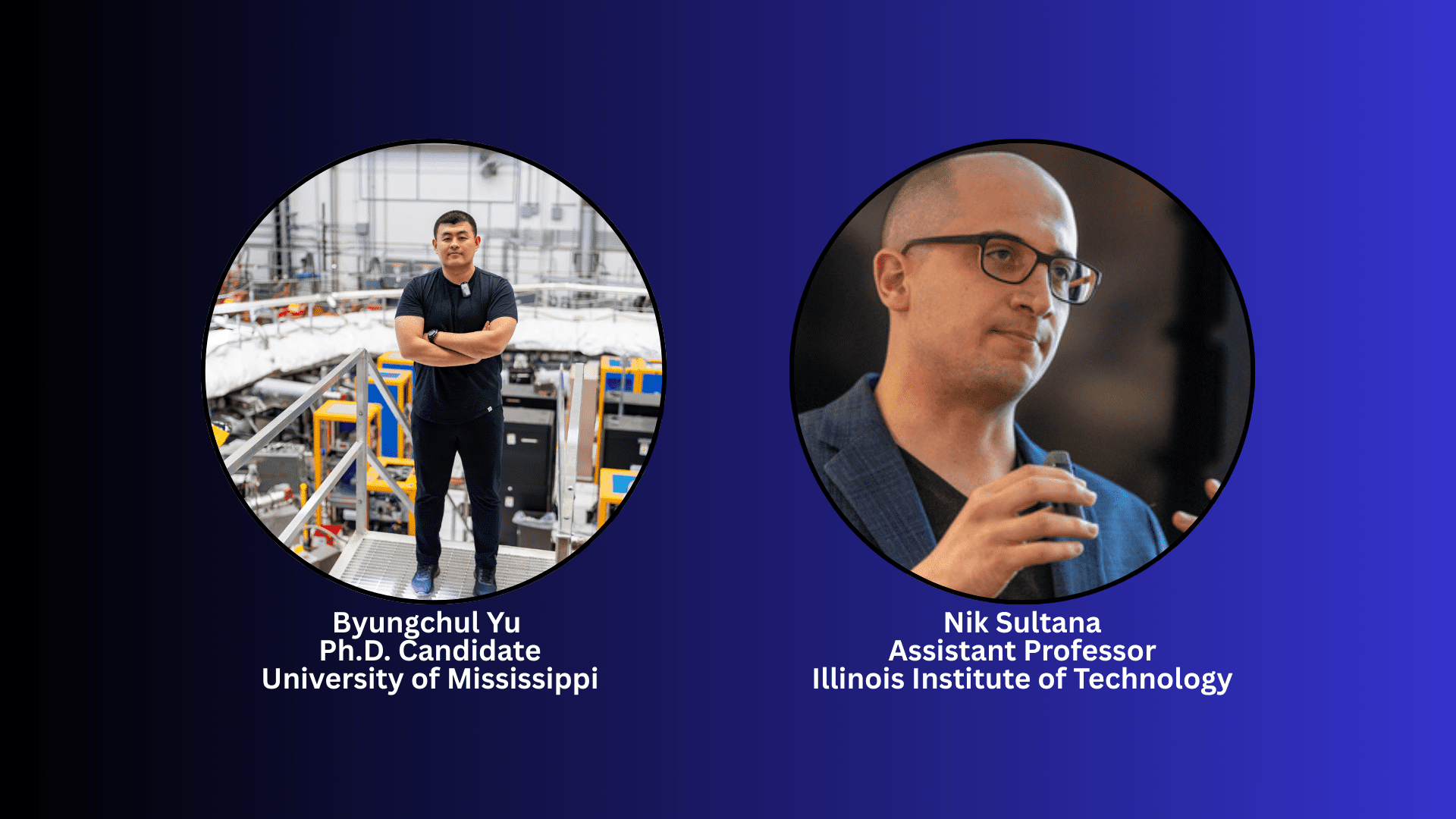
At first glance, Byungchul Yu and Nik Sultana work in very different corners of science. One searches for the universe’s most elusive substance; the other studies the digital pathways that allow modern experiments to function at all. Yet both are united by curiosity, collaboration, and the opportunities made possible through the URA’s Visiting Scholars Program (VSP) at Fermilab.
Together, their stories show how fundamental physics and advanced computing intersect and why society benefits from investments in both.
Chasing the Universe’s Biggest Mystery
For Byungchul Yu, a graduate student and Ph.D. candidate in experimental physics at the University of Mississippi, Fermilab has been a dream destination since childhood. Now based at the lab through the URA VSP from 2023 to 2025, Yu is using precision measurements from the Muon g-2 experiment to search for dark matter.
“Dark matter makes up most of the matter in space,” Yu explained. “We know it has mass, but we don’t know much about it.”
At Fermilab, multiple experiments probe this mystery, and Yu’s work focuses on how dark matter might interact with muons – subatomic particles similar to electrons but heavier. While many searches for particle-like dark matter have come up empty, Yu is exploring alternative possibilities, including whether dark matter could behave more like a wave.
When asked what would happen if dark matter were proven, he smiled and said, “It would be of Nobel Prize-level significance. It would fundamentally change our understanding of dark matter.”
Yu is deeply motivated by what such discoveries could mean for humanity. He points to history for perspective such as the electron. “Many years ago, we didn’t know about electrons but once we did, it enabled many technological advances, such as computers or scanners, that we rely on today.”
To Yu, fundamental physics is a reflection of human curiosity itself. He likens scientific progress to lighting torches in a dark room; each discovery illuminates a little more, making the unknown increasingly accessible. “Today, we’re standing in front of a door labeled ‘Dark Matter,’” he said. “We can’t open it yet because it’s still dark on the other side. But the more torches we light through particle physics and research, the closer we get to unlocking it.”
The URA VSP made it possible for Yu to pursue this work with focus and independence. The program allowed him to be based at Fermilab, supported his research flexibility, and provided critical funding especially meaningful as an international scholar.
That support connects back to Yu’s earliest inspirations. Growing up in South Korea, where research infrastructure was limited at the time, Yu’s father encouraged curiosity. At age 14, Yu began asking teachers a simple question: What is the universe made of? When no one had a clear answer, one teacher challenged him to find out himself.
Now, Yu is doing exactly that.
In addition to VSP, URA’s SPARC program helped him step back and reflect on the broader purpose of his work. “It acted as a catalyst,” he said. “It reinforced my responsibility as a scientist to pursue my work with greater meaning.”
When he’s not in the lab, Yu brings that same sense of exploration outdoors: hiking, camping, and biking long distances. He has even traversed from Los Angeles to New York, entirely by bicycle. “I don’t want to rely on a car,” he said. “I like to experience the journey.”
Building the Invisible Infrastructure of Discovery
While Yu searches for what the universe is made of, Professor Nik Sultana focuses on how scientific discoveries move from detectors to computers to researchers around the world.
An assistant professor of computer science at the Illinois Institute of Technology, Sultana participated in the URA VSP at Fermilab in Spring 2025 as a faculty scholar. His research centers on computer networks and how to make better use of them for large-scale scientific infrastructure.
Modern physics experiments generate enormous volumes of data. Detectors observe rare events, digitize them, and send the information across complex networks for analysis. Between observation and computation lies a critical question: how fast, efficiently, and securely can that data move?
“Time to science is time to discovery,” Sultana said, pointing to the importance of reducing latency while managing ever-growing data volumes.
At Fermilab, this challenge is particularly acute for experiments like DUNE, which will produce unprecedented amounts of data. Sultana’s work explores how networks and even less mainstream computer hardware can be optimized to meet these demands. His team recently published a paper demonstrating how detector data can be fully parsed on more accessible, mainstream hardware, revealing both new possibilities and constraints.
The societal impact, he notes, is closer than many people realize. “Computer networks led to the internet,” Sultana said. “But they’re also used in places we don’t usually hear about like particle detectors.”
Through the VSP, Sultana expanded his collaborations with researchers at Fermilab and CERN, and brought students into the process. Two members of his research group (Bjørn Ove Sagstad, Nishanth Shyamkumar) and even a visiting high school student from Chicago (Sophia Chen) contributed to the published paper. “That’s something I wouldn’t have been able to do otherwise,” he said.
The experience has also shaped his role as an educator. “I never stopped being a student,” Sultana reflected. “I learn along the way how to teach.”
He regularly attends Fermilab users’ meetings and is continuing to develop a live demonstration of his work, which he plans to present at an upcoming supercomputing conference. What he learns through VSP doesn’t stay at the lab, it comes back to his classroom, his students, and his institution.
Different Paths, Shared Purpose
From probing dark matter to accelerating data flow, Yu and Sultana exemplify the breadth of research supported by the URA Visiting Scholars Program. Their work highlights a simple truth, discovery doesn’t happen in isolation. It depends on people, infrastructure, curiosity, and the freedom to explore big questions.
For Yu, that means standing at the edge of the unknown, torch in hand. For Sultana, it means building the networks that let those torches shine farther and faster. Together, they are helping illuminate the future of science one question, one connection, and one discovery at a time.
ABOUT VSP
The URA Visiting Scholars Program (VSP), established in 2007, continues to play a vital role in advancing discovery by supporting faculty, postdoctoral researchers, and graduate students from URA-member institutions in pursuing research at Fermilab. Funded through contributions from more than 90 universities, the program enables visits ranging from short-term participation in conferences and summer schools to year-long research stays at the Lab.
ABOUT URA
Universities Research Association (URA) is a not-for-profit 501(c)(3) with a mission to augment the exchange of expertise between universities and national labs to accelerate innovation and scientific discovery. URA is an academic consortium composed of over 90 premier research universities across the United States, United Kingdom, and Italy headquartered in Washington, D.C; a parent company in the management and operation of Fermilab; a member of Honeywell’s National Technology and Engineering Solutions of Sandia (NTESS) for the management and operation of Sandia National Laboratories; and a financial steward for the National Science Foundation for nation’s participation in the Pierre Auger Cosmic Ray Observatory in Argentina.
###
For More Information:
URA Communications – communications@ura-hq.org