



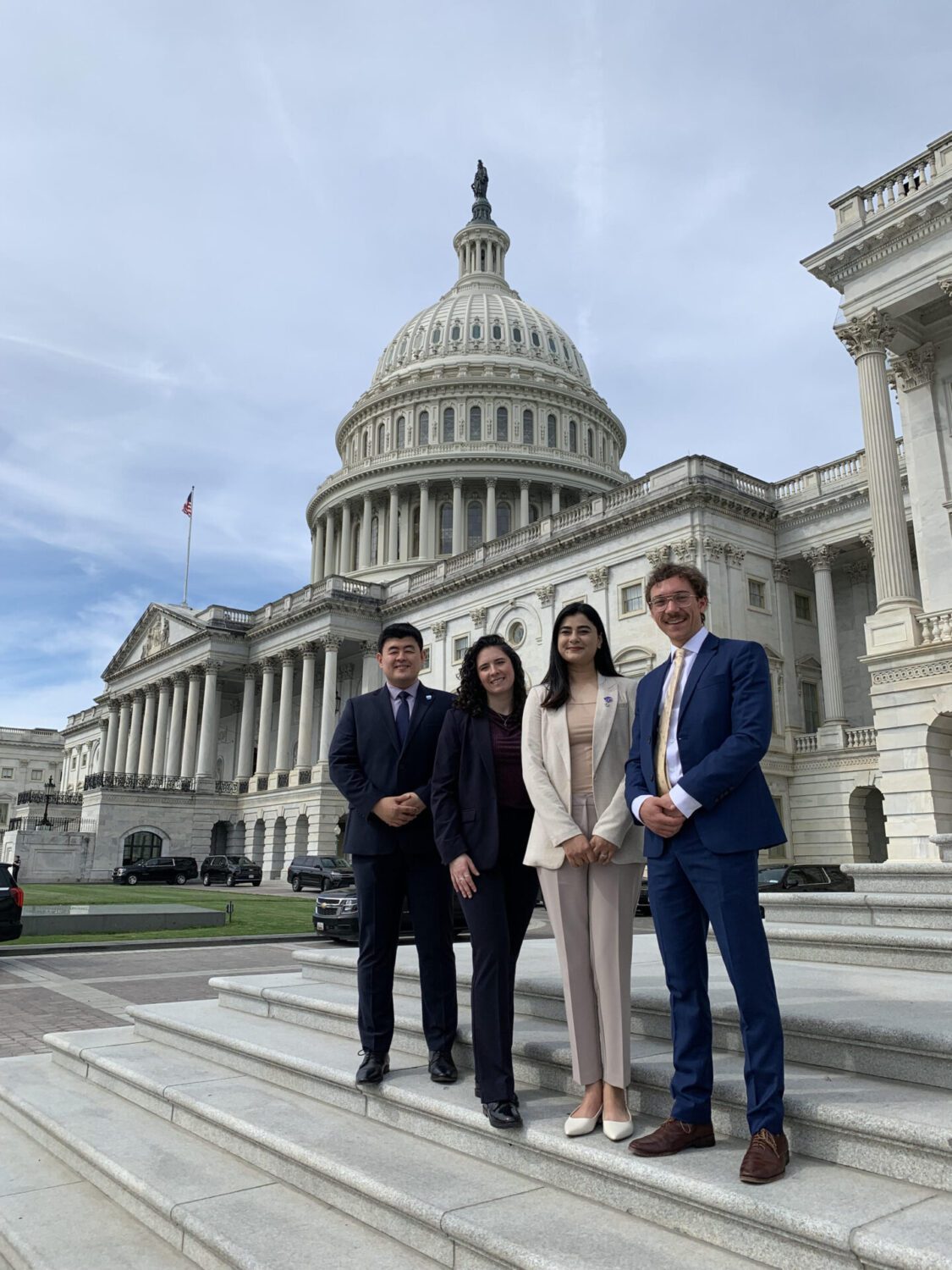
WASHINGTON, D.C. – While most graduate research happens behind shielded laboratory walls or deep within data sets, a select group of physicists recently traded their research uniforms for business attire to take on the halls of Congress. Winners of the Science Policy and Advocacy for Research Competition (SPARC) arrived to D.C. for the SPARC Policy Summit held on April 15-17, 2026, to bridge the gap between fundamental physics and federal policy. The group’s itinerary featured high-level discussions with key decision-makers in Congress, including a personal meeting with Representative Bill Foster (IL-11), the only Ph.D. physicist in Congress. The scientists also engaged in dialogues with leadership at the Department of Energy (DOE) Office of Science and the White House Office of Science and Technology Policy (OSTP). Through these meetings, the SPARC winners moved beyond theoretical equations, demonstrating how the work being done at Fermilab and its partner universities translates into tangible national benefits – from advanced technological infrastructure to the cultivation of the next generation of the American scientific workforce.
The delegation included Byungchul Yu (University of Mississippi), Nabila Majeed (Kansas State University), Gabi Hamilton (University of Virginia), and Colin Weber (University of Minnesota Twin Cities).
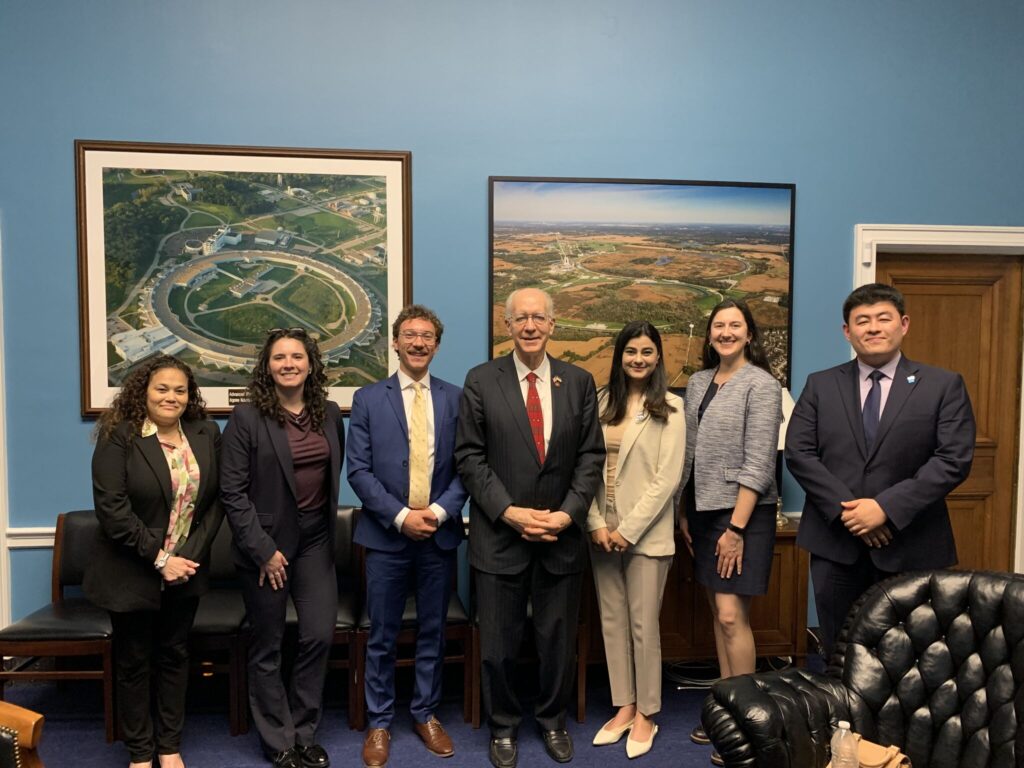
SPARC Champions with Representative Bill Foster (IL-11).
Read about some of their experiences below:
Colin Weber
For a couple of years during my physics PhD program, my colleagues at the University of Minnesota and I would gather at a coffee shop on Tuesday mornings to do work. We chose a time during which none of us had meetings and would enjoy a good drink and camaraderie while each of us worked on writing, coding, or doing whatever other tasks needed to get done for our thesis research. We would aim to arrive around eight o’clock, because by nine all of the seats by power outlets would be taken.
At this coffee shop, I always enjoyed imagining the jobs that the other coffee shop customers were doing. I met a few customers over the years, enough to convince me that any job that can be done remotely was probably done at that coffee shop at some time or other. I loved the bustle of the shop, from the sounds of the keyboards clacking to the dull hum of the Zoom meetings happening around the shop. Work was getting done there.
I’m pleased to report that if you replace all of those virtual interactions with in-person ones, but keep the same bustling atmosphere, then you get something that looks like the Starbucks in the basement of Longworth, one of the U.S. House of Representatives’ office buildings. When I had the opportunity to pass through during URA’s Science Policy Summit, nearly every table was filled with young congressional staffers, typically in pairs, chatting on behalf of the office they work in. I later learned that these conversations were almost all for networking with other offices, trying to find areas of common interest, or even just learning about what other issues offices are thinking about. It is these connections that the staffers then bring to their Members of Congress, forming the intricate web of relationships through which information flows on the Hill. Work was getting done there.
Visiting the Longworth Starbucks showed me that without these congressional staffers, and given the complexity of the issues we face today, there’s no way information could flow around Congress quickly enough for any progress to be made. The converse is true too: without the staffers, many of whom are fresh out of college, the federal government would halt. I say this not to provoke people into thanking their Representative’s staff (although that action would be well-received!), but to point out a new appreciation I have for an invaluable political skill. Politicians must be capable of assembling and retaining an excellent staff to help them establish their networks in order to get their job done. Now, I’m not saying that my next vote cast will be decided based on which candidate has the best HR skills, but if faced with a choice between the lesser of two evils, I know what can sway me.
Gabi Hamilton
Most scientists view policy through a narrow lens: we do important work, so the government should give us more money. My interest in the SPARC Policy Summit was different. I wanted to see the “backstage” of science—the machinery of how decisions are made, priorities are set, and whether funding models are truly efficient. Having previously met with Congressional offices, I focused this trip on the pragmatism of the Executive branch.
In the High Energy Physics (HEP) academic circle, there is a prevailing narrative that we are constantly struggling for resources. However, my time at the Department of Energy (DOE) and the Office of Science and Technology Policy (OSTP) challenged that bubble. Speaking with Dr. Regina Rameika at the DOE was enlightening. As a former scientist in the field, she offered a perspective that was far from naive and much more centered and pragmatic than what I commonly hear in the community. She was clear: HEP funding is actually quite strong, but the government cannot fund every project. The job isn’t just about “supporting science.” It’s about the difficult, high-stakes task of deciding which projects are truly worth the public’s time and investment. She contrasted it with the Nuclear Physics field, which often struggles to decide on its priorities due to many competing voices, while HEP has a thorough review process called P5 to address exactly those issues.
This realization shifted my perspective on what it means to be a leader in science. It’s not just about the technical mastery of a detector or a theory. It’s also about project decision-making, managing projects, and managing people. I found myself less interested in the role of a congressional staffer, which can often feel distanced from actual value creation, and more interested in the ability to support large-scale projects to be cheaper, faster, and more efficient in a more direct way.
The most valuable lesson I picked up wasn’t about physics at all, but about “reading the room.” During a meeting with a Senate advisor, I saw firsthand how shifting an approach can change the energy of a conversation. While discussing the impact of tariffs on detector materials, I brought up our new director, Norbert Holtkamp, and the specific strategic approach he is bringing to the lab. I could see an immediate shift in the advisor’s engagement once they realized our leadership’s priorities aligned with their own office’s political and professional leanings.
Advocacy is an active, tactical process. I saw how easily a conversation can lose momentum when the technical details don’t match the listener’s interests, and I practiced the skill of redirecting those discussions toward more productive ground. It reinforced a hard truth: science is a human endeavor. We are flawed, biased, and we must develop the “soft skills” necessary to navigate the world outside the lab if we want our work to have an impact.
My advice to a colleague heading to D.C. would be this: Remember that policymakers are just people. They have very little time, so get to the point and meet them halfway. This experience taught me that my professional identity is of someone who needs to understand the people, the politics, and the economics that allow science to exist in the first place. My goal isn’t just to do the work, but to eventually be in the position to decide how we can fund and manage it more effectively to ensure science creates the most value for society.
Byungchul Yu
When most people ask what I do and hear that I study physics, the reaction is usually similar. There is a short pause, a polite smile, and then something like, “That sounds hard,” or “Wow, that’s pretty intense.” That moment always makes me pause. Why does physics feel so distant? As children, many of us have looked up at the night sky and wondered about it: what is out there, how far does it go, or are there aliens? That curiosity has not disappeared. Somewhere along the way, however, a gap has formed between science and society. I began to think about what creates that distance, and more importantly, how it can be reduced. That question led me to the SPARC program. Through the program, I learned that science moves forward through connection. Curiosity, understanding, and public engagement are all part of that process, but they only work when science remains closely connected to society. Communication is what sustains that connection. It brings science to people, helps them see why it matters, and inspires the next generation to carry science forward.
The SPARC Policy Summit in Washington, D.C. expanded my understanding of how science connects with society. Through meetings with congressional offices, the Office of Science and Technology Policy (OSTP), and the Department of Energy (DOE), I saw that those who shape science policy and support research also play a critical role in this connection. Before the congressional visits, there was uncertainty about how much impact a brief conversation could have or even what these meetings were meant to accomplish. That perspective began to shift during the conversations. Members of Congress and their staff showed genuine interest in our research. They asked thoughtful questions about our progress and the challenges we face. The discussions felt engaged and thoughtful, with a shared interest in supporting research. This made the meetings feel far more productive than expected and highlighted the value of direct interaction.
Conversations at OSTP and DOE deepened my understanding of how scientific priorities are shaped and supported at the national level. I began to see more clearly that progress in fundamental physics depends on coordinated support across multiple levels, from long-term strategy to program-level decisions. I was struck by how decisions are made with a long-term outlook, where the goal is not only to support ongoing research but to build a foundation for future scientific progress. This experience helped connect my own work to a larger system that enables and sustains discovery. This experience changed how I think about my role as a scientist. Research is not only about advancing knowledge, but also about making that knowledge accessible and meaningful beyond the scientific community. The distance between science and society does not close on its own. It requires consistent effort through communication, engagement, and trust. The SPARC program showed that even brief conversations can help bridge that distance.
Moving forward, I hope to carry this perspective into my work and contribute to building stronger connections between science and the broader community. If there is one piece of advice I would give, it is this: Communication that is easy to understand is what keeps science connected to society. Science does not become distant because it is inherently difficult, but because it is often framed in ways that limit accessibility – and that is something we can change.
Nabila Majeed
As an early career scientist, I have often felt that the work we do especially in fundamental research is difficult to explain outside our field. Despite years of training in technical skills, I never had the opportunity to formally learn how to communicate complex ideas to non-scientists. That is what motivated me to pursue the SPARC program: a chance to develop the ability to translate science into something understandable for a broader audience. Science communication is essential because it connects research with society. Public funding supports much of the work we do, and with that comes a responsibility to build trust and understanding. Clear communication not only helps justify that investment but also inspires future generations to engage with science. One of my biggest takeaways from the SPARC Policy Summit in Washington, D.C. was how genuinely interested policymakers are in science. In meetings across federal agencies and congressional offices, I found them curious, engaged, and eager to hear directly from researchers. It also highlighted the need for stronger scientific voices in policy decisions. I had never interacted with policymakers before and imagined these meetings as distant or one-sided. But in reality, they were dynamic and conversational.
At offices like the Department of Energy (DOE) and the Office of Science and Technology Policy (OSTP), I was able to ask questions about how policies are shaped and the challenges of supporting scientific research. While the congressional office felt more familiar especially when speaking with someone with a physics background, which made it easier to connect on technical ideas. I was particularly struck by how quickly Senate staffers grasp unfamiliar topics and link them to policy priorities. One of the most valuable lessons I learned was the power of real-world examples. By using examples of discoveries made years ago that have become impactful today, I was able to convey why sustained support for basic research matters. These kinds of analogies helped make abstract ideas more relatable and reinforced the importance of patience in scientific progress.
This experience also reshaped how I see my role as a scientist. Beyond conducting research, I now view communication, advocacy, and engagement as essential parts of my professional identity. Scientists can act as a bridge by translating complex research into simple ideas that connect science to policymaking and understandable to the public. Looking ahead, this experience will influence how I write grant proposals and talk about my work. I will place greater emphasis on clarity, simplicity, and long-term impact.
For colleagues who feel hesitant about speaking with policymakers, my advice is simple: go for it. You don’t need to be perfect, these conversations are opportunities to learn, connect, and grow. Finally, one unspoken lesson I took from Washington is that these spaces are more welcoming than we often assume. People are attentive, respectful, and eager to listen. The SPARC Policy Summit showed me that meaningful dialogue between science and policy is not only possible in-fact it is necessary.
ABOUT SPARC
SPARC is designed to enhance awareness of the science policy engagement process for early career scientists to help bridge the gap across the science and policy sectors. Over a 10-week period, students engage virtually in active seminars with experts in science policy and communication. The program culminates in a competition with emerging SPARC Champions visiting Washington D.C. for the Science Policy Summit. Through seminars, workshops, and individual drafting sessions, participants develop research and communication skills to build their science policy portfolios.
ABOUT URA
Universities Research Association (URA) is a not-for-profit 501(c)(3) with a mission to augment the exchange of expertise between universities and national labs to accelerate innovation and scientific discovery. URA is an academic consortium composed of over 90 premier research universities across the United States, United Kingdom, and Italy headquartered in Washington, D.C; a parent company in the management and operation of Fermilab; a member of Honeywell’s National Technology and Engineering Solutions of Sandia (NTESS) for the management and operation of Sandia National Laboratories; and a financial steward for the National Science Foundation for nation’s participation in the Pierre Auger Cosmic Ray Observatory in Argentina.
###
For More Information About URA:
URA Communications – communications@ura-hq.org