


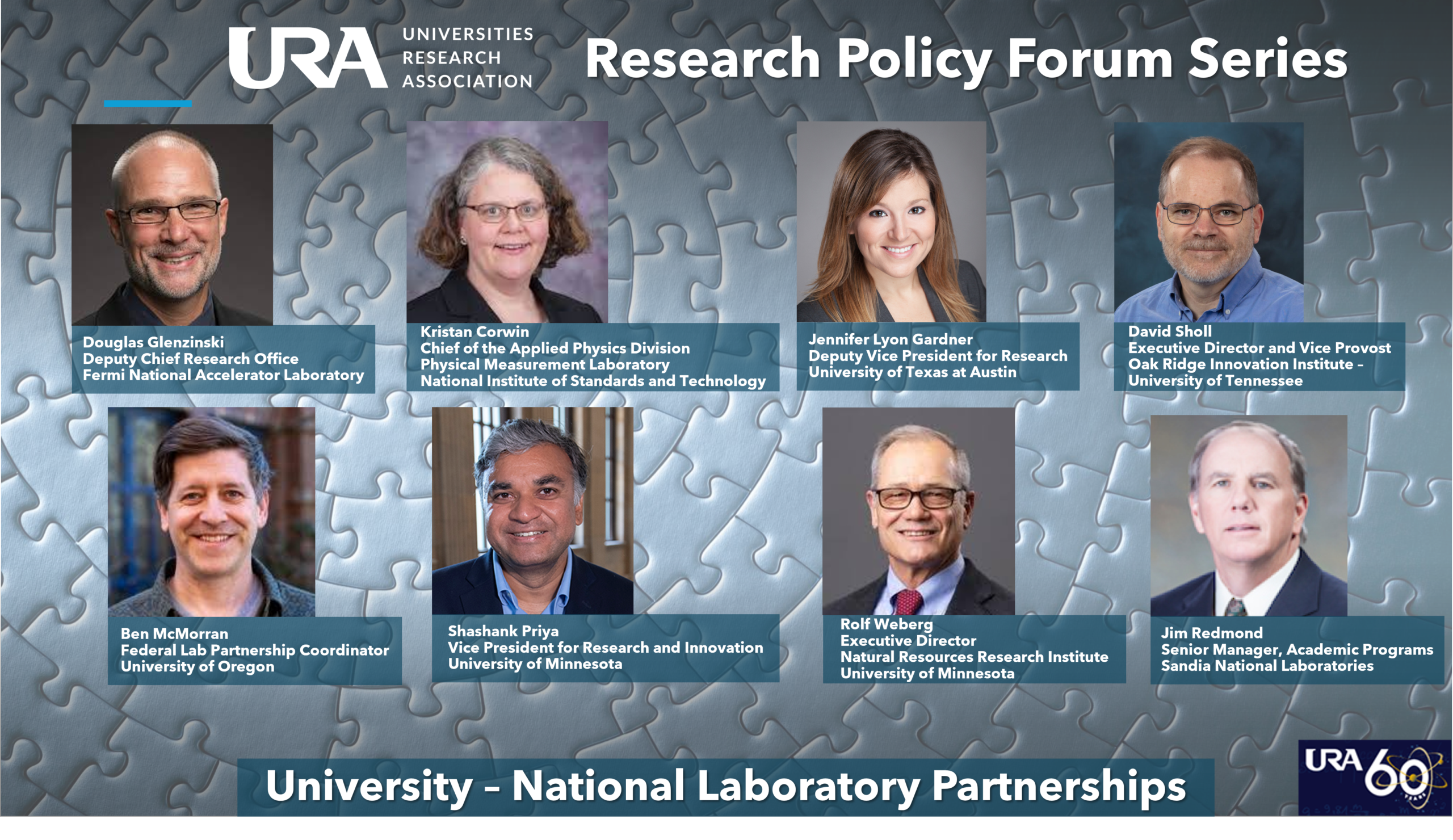
VIRTUAL – The URA convened its latest Research Policy Forum University-National Laboratory Partnerships in September 2025 to spotlight collaborations and strengthen partnerships between U.S. universities and national laboratories. The event brought together leaders from academia and the national lab ecosystem to discuss how research collaborations are advancing cutting-edge science, developing the STEM workforce, and overcoming institutional barriers.
The URA was founded in 1965 by 34 U.S. universities with the primary goal of designing, building, and operating a proton accelerator, a project that would eventually become the foundation of Fermi National Accelerator Laboratory. This early collaboration brought together a small group of high-energy physics researchers from academia to shape the scientific strategy of the lab. Rooted in this legacy of fostering strong academic and national lab partnerships, URA has continued to play a key role in bridging these two sectors.
In 2020, URA convened a virtual roundtable discussion with representatives from its member universities to explore how collaborations between universities and U.S. Department of Energy National Laboratories could be strengthened. The Roundtable, held in October under the theme “Effective University-National Laboratory Partnerships – A Look to the Future”, aimed to generate forward-looking recommendations to inspire new partnership approaches and guide URA member institutions, national laboratories, and government policymakers.
Building on the insights and recommendations from the 2020 discussions, the recent forum brought together representatives to share the latest developments in University-National Laboratory partnerships. This time, the focus shifted to tangible examples of how these collaborations have evolved and the real-world impact they are having.
Representatives from Fermilab, Sandia National Laboratories, University of Texas at Austin, University of Oregon, University of Tennessee, University of Minnesota, and the National Institute of Standards and Technology showcased how these partnerships are being built, and how providing students, postdocs, and faculty the opportunity to engage in research with national lab scientists has not only created workforce development pathways and innovation pipelines, but also strengthened the labs’ ability to accomplish their science missions.
Dr. Jennifer Lyon Gardner, Deputy Vice President for Research at the University of Texas at Austin, outlined UT-Austin’s proactive strategy to foster lab-university connections. The university facilitates researcher matchmaking through a formal request system, and hosts targeted networking events. Gardner emphasized the importance of building personal relationships that can endure beyond institutional frameworks. Dr. Douglas Glenzinski, Deputy Chief Research Officer at Fermilab, emphasized that the lab’s mission is “primarily one of science, fundamental science, and pushing the boundaries of knowledge at the frontier.” These partnerships, both domestic and international, help push the boundaries of science.
Drawing from the full set of presentations, the forum affirmed that university-national laboratory partnerships are entering a new phase defined by intentional structure, shared investment, and coordinated strategy. Institutions across the country are moving beyond informal collaborations toward models built on joint appointments, embedded partnership managers, co-funded initiatives, and transparent governance that align research priorities and sustain long-term impact. Speakers emphasized that workforce development remains the unifying priority, from K-12 outreach and experiential learning to graduate education, internships, and postdoctoral training, forming a national pipeline essential to U.S. scientific leadership. The discussions also addressed the growing reliance on data-driven decision-making, with laboratories increasingly using metrics and performance dashboards to guide partnership strategy and measure outcomes. Yet even with stronger systems in place, participants stressed that cultural fluency, trust, operational alignment, and relationship-building continue to be the foundation of durable collaboration. Together, these insights reveal a research ecosystem that is becoming more integrated, equitable, and purpose-driven, reflecting a shared commitment to advancing discovery and cross-sector innovation, expanding opportunity, and strengthening the nation’s scientific competitiveness.
ABOUT URA
Universities Research Association (URA) is a not-for-profit 501(c)(3) with a mission to augment the exchange of expertise between universities and national labs to accelerate innovation and scientific discovery. URA is an academic consortium composed of over 90 premier research universities across the United States, United Kingdom, and Italy headquartered in Washington, D.C; a parent company in the management and operation of Fermilab; a member of Honeywell’s National Technology and Engineering Solutions of Sandia (NTESS) for the management and operation of Sandia National Laboratories; and a financial steward for the National Science Foundation for the nation’s participation in the Pierre Auger Cosmic Ray Observatory in Argentina.
###
For More Information:
URA Communications – communications@ura-hq.org