



URA is spotlighting two of its 2025 Science Policy & Advocacy for Research Competition (SPARC) participants whose work stretches from the smallest particles in the universe to the biggest questions humans can ask like why is there something rather than nothing? Or equally important: Can you birdwatch at a national laboratory? (Turns out, yes.)
This year’s cohort features Colin Weber, a neutrino-chasing Ph.D. candidate at the University of Minnesota’s School of Physics and Astronomy, and Lucy Kotsiopoulou, a Fermilab-based Ph.D. candidate soon heading back to the University of Edinburgh’s School of Physics and Astronomy. While their science is serious, both bring a welcome dose of curiosity, creativity, and personality to the world of particle physics.
Colin Weber: The Neutrino Detective Who Also Plays Saxophone
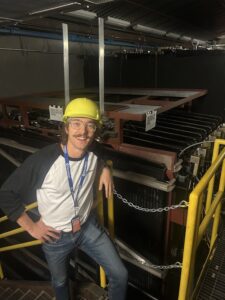
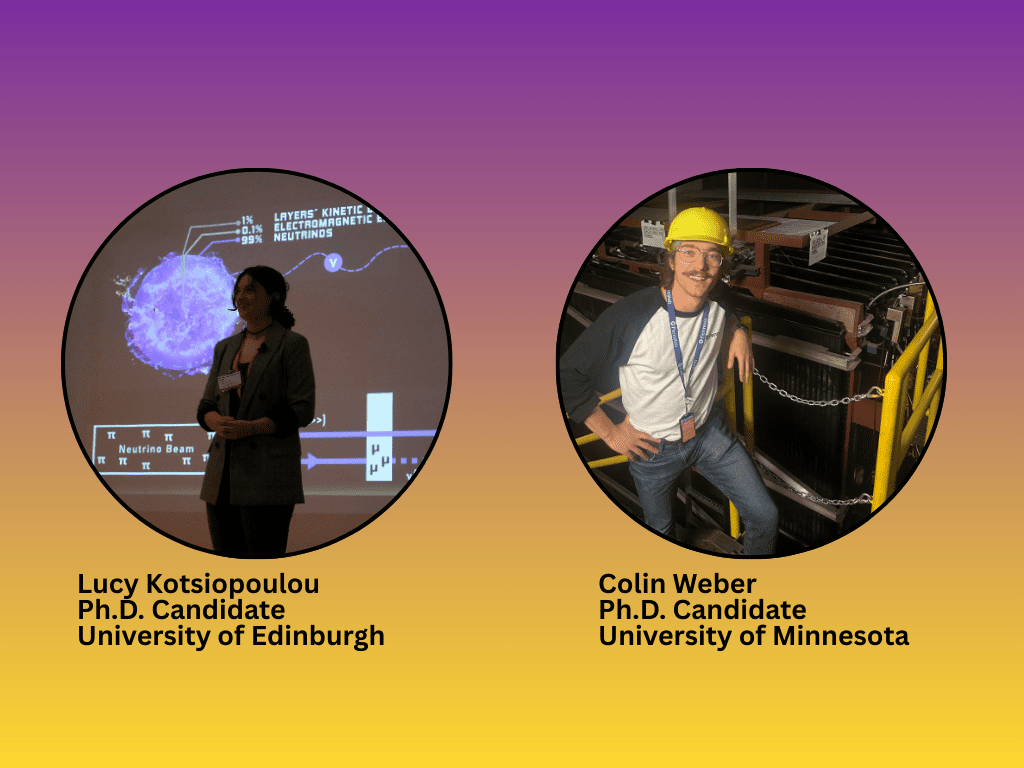
Image: Colin Weber
Colin Weber arrived at Fermilab through URA’s Visiting Scholars Program – a program he discovered thanks to a very persuasive best friend and quickly found himself immersed in the world of neutrino cross sections. His mission – understand how neutrinos interact with the nuclei they pass through and ultimately help experiments like NOvA (NuMI Off-axis νe Appearance) and the upcoming mega-experiment DUNE decode the mysteries of the universe.
“Understanding neutrinos might help explain why there’s more matter than antimatter,” Weber explains. “Which is another way of saying: why any of us exist at all.” No pressure.
Through SPARC, Weber is sharpening one of the tools scientists need almost as much as a particle detector – the ability to explain mind-bending science to everyday people. With science funding under pressure, he believes researchers must become their own advocates. SPARC, he says, helps him learn how to do just that.
When he’s not uncovering the secrets of the cosmos, Weber is running (sometimes on trails), reading Tolkien (he’s a true Lord of the Rings fan), or jamming with Fermilab musicians on his saxophone. Rumor has it that if neutrinos ever form a band, he’ll be the first to join.
Lucy Kotsiopoulou: From Dark Matter to Supernovae… and Also Birdwatching
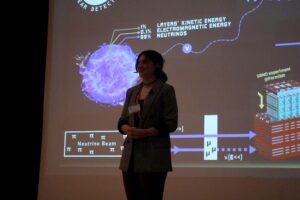
Image: Lucy Kotsiopoulou. Credit: Anna Beever.
Lucy Kotsiopoulou’s work spans experiments at Fermilab and in Italy, where she helps operate large liquid-argon detectors used to study neutrinos and dark matter. For a project in Italy, she works on DarkSide-20k, an experiment designed to search for dark matter that could also detect supernova neutrinos. At Fermilab, she contributes to the Short-Baseline Near Detector which studies neutrinos from a beam and helps researchers understand how supernova neutrinos would interact with argon while we await the next stellar explosion.
“People asked scientists ‘so what?’ when the proton was discovered more than 100 years ago,” she says. “Now proton therapy saves lives. Neutrino and dark matter research could lead to breakthroughs we can’t even imagine yet.”
That’s exactly the perspective Kotsiopoulou brings to SPARC, a knack for explaining research in unexpected, creative ways. She’s a lifelong science communicator – founder of her university’s physics society, social media lead, and always on the hunt for new angles that make particle physics click for the public.
Outside the lab, Kotsiopoulou’s passions are equally cosmic and grounded: she’s a Halloween enthusiast, mythology reader, amateur photographer, and a birdwatcher thanks to Fermilab’s sprawling nature reserve. (Neutrinos aren’t the only elusive things worth tracking at Fermilab.)
Uniting Science, Communication, and Community
Both Weber and Kotsiopoulou say SPARC has broadened their networks, deepened their understanding of science advocacy, and helped them develop new ways to share their work with the public. Whether explaining CP violation or comparing supernovae to cosmic fireworks, they’re part of a new generation of scientists who see communication as essential – not optional.
And with participants like these, the future of science outreach looks bright… and occasionally musical.
ABOUT SPARC
SPARC is designed to enhance awareness of the science policy engagement process for early career scientists to help bridge the gap across the science and policy sectors. Over a 10-week period, students engage virtually in active seminars with experts in science policy and communication. The program culminates in a competition with emerging SPARC Champions visiting Washington D.C. for the Science Policy Summit. Through seminars, workshops, and individual drafting sessions, participants develop research and communication skills to build their science policy portfolios.
ABOUT URA
Universities Research Association (URA) is a not-for-profit 501(c)(3) with a mission to augment the exchange of expertise between universities and national labs to accelerate innovation and scientific discovery. URA is an academic consortium composed of over 90 premier research universities across the United States, United Kingdom, and Italy headquartered in Washington, D.C; a parent company in the management and operation of Fermilab; a member of Honeywell’s National Technology and Engineering Solutions of Sandia (NTESS) for the management and operation of Sandia National Laboratories; and a financial steward for the National Science Foundation for nation’s participation in the Pierre Auger Cosmic Ray Observatory in Argentina.
###
For More Information:
URA Communications – communications@ura-hq.org