
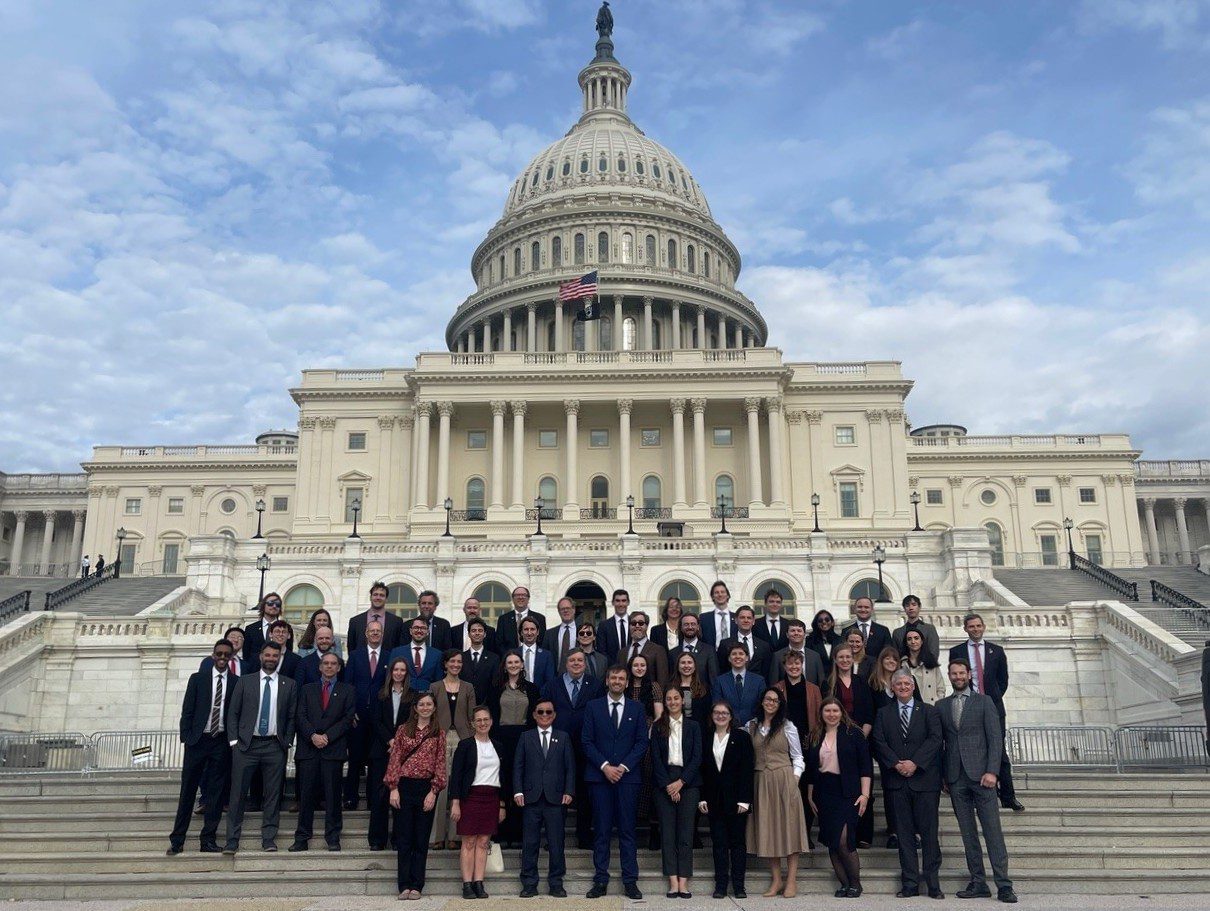
Washington, D.C., March 27, 2026 – Scientists and research leaders from across the United States gathered in Washington, D.C. during the week of March 23–27, 2026, for the annual High Energy Physics (HEP) Community Visit. The event brought together a broad coalition of the particle physics community to engage with Congress and federal agencies on the importance of continued investment in fundamental research and particle physics.
Organized with participation from leading groups -the Users and Affiliates Executive Committee at Fermilab, the U.S. Large Hadron Collider Users Association, SLAC Users Organization, and Sanford Underground Research Facility- the visit represented a united and coordinated national effort across universities, national laboratories, and major international collaborations.
The week began with a kickoff hosted by Universities Research Association (URA), setting the stage for a series of meetings with Congressional offices on Capitol Hill and key federal agencies. These included the White House Office of Science and Technology Policy, the National Science Foundation’s Directorate for Mathematical and Physical Sciences, the Office of Management and Budget, the U.S. Department of State, and the U.S. Department of Energy’s Office of Science. These discussions centered on the critical role of particle physics in advancing both scientific knowledge and practical innovation.
“Fundamental research is essential to expanding the frontiers of knowledge and building the scientific foundations that drive innovation, economic growth, and solutions to global challenges,” said John Mester, President and CEO of URA.
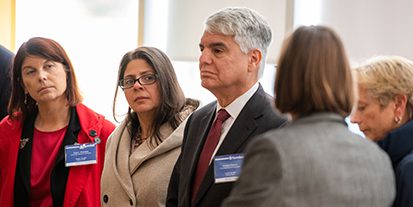
On March 25, URA hosted a networking reception that brought together members of the HEP delegation and partners from across the science and policy ecosystem. Attendees included representatives from the American Physical Society, as well as Eric Burlison (MO-7), demonstrating the importance of ongoing dialogue between the scientific community and policymakers.
The 2026 HEP Community Visit reflects the strength and unity of the U.S. particle physics community, which, through sustained collaboration across universities, national laboratories, and international partners, continues to advance discovery and deliver lasting benefits to society as the nation considers its scientific priorities.